

There are moments in life that seem small at the time, but later you realize they changed the direction of everything. For me, one of those moments happened when Iowa Workforce directed me toward earning my diploma.
At the time, it may have looked like a referral, a next step, or one item on a checklist. But for me, it became a turning point. Adult Basic Education did not just help me earn a credential. It helped me begin to see a future again. It helped me rebuild confidence. It helped me understand that education was not something I had failed at. It was something I had not yet been supported through in the right way.
Adult learners are often described by what they have not completed yet. They may not have a diploma. They may need stronger reading, writing, math, digital literacy, or English language skills. They may be navigating employment, family responsibilities, transportation barriers, childcare, health issues, financial pressure, or past educational experiences that were not built for them.
Adult Basic Education is not about fixing people. It is about creating pathways where adults can keep moving forward.
That is why this work matters to me. I came into Adult Basic Education as a learner. Over time, I began to understand it from other angles too: student advocacy, program support, data, reporting, registration, persistence, workforce readiness, and systems change. The more I learned, the more I saw that Adult Basic Education is not just a classroom service. It is part of the foundation of healthy communities.
Adult Basic Education Is More Than a Credential
For many adults, earning a high school equivalency diploma is an important goal. It can open doors to employment, college, training, promotions, and personal pride. But if we only talk about Adult Basic Education as a credential pathway, we miss much of its value.
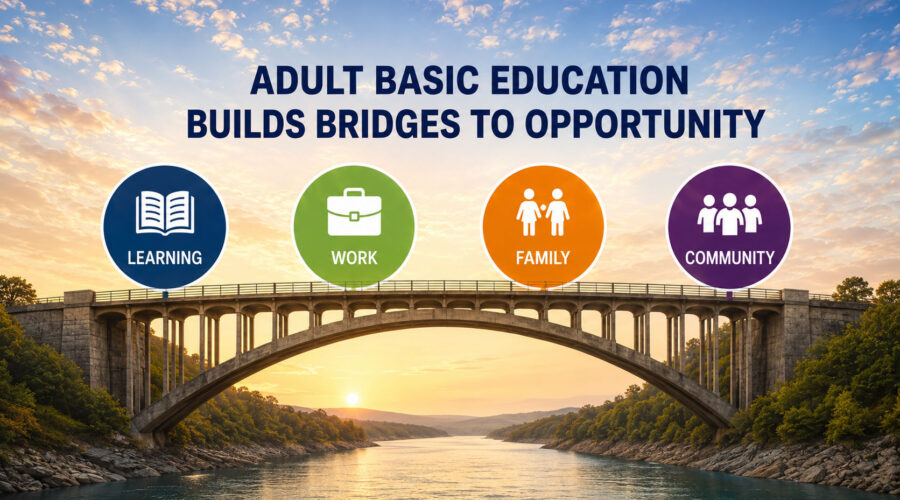
Adult Basic Education connects more than classrooms. It supports families, workplaces, and communities.
Adult Basic Education also helps adults strengthen reading, writing, math, English language proficiency, and problem-solving skills. The U.S. Department of Education describes adult education and literacy programs as helping adults acquire basic skills in reading, writing, math, English language proficiency, and problem-solving so they can participate more fully as workers, family members, and citizens (U.S. Department of Education, n.d.).
Adult Basic Education can support adults as they:
- Earn a high school equivalency diploma
- Strengthen reading, writing, math, and digital literacy skills
- Build English language proficiency and communication confidence
- Prepare for employment, college, training, or advancement
- Navigate family, workplace, healthcare, and community responsibilities
That description matters because adults do not use education in only one part of life.
A parent may use reading skills to help a child with homework, understand school forms, or communicate with a teacher. A worker may use math and digital skills to apply for a better job, read a schedule, complete training, or understand safety information. A community member may use language and literacy skills to advocate for themselves, navigate healthcare, participate in civic life, or support others.
The credential matters. But so do the moments that happen along the way:
- The confidence that grows over time
- The moment a learner says, “I can do this”
- The shift from surviving a system to participating in it with more power and dignity
Adults Are Not Starting Over
One of the phrases I keep coming back to is this:
Adult learners are not starting over. They are continuing forward.
Adult learners bring full lives with them
- Work histories
- Parenting and caregiving experience
- Community knowledge
- Cultural strengths
- Survival skills and problem-solving abilities
- Responsibilities that may never appear on an intake form
That may sound simple, but it changes how we design programs.
Some adults arrive carrying shame from past school experiences. Some have been told, directly or indirectly, that education was not for them. Some have tried before and had life interrupt the process. Some are balancing class with night shifts, children, transportation issues, immigration processes, housing instability, health needs, or the pressure to earn income right now. That does not mean they lack motivation. It means persistence is more complicated than motivation.
Practitioners know this. Program staff see it every day. A student may miss class because their car broke down, because a child got sick, because their work schedule changed, or because they had to choose between attending class and paying a bill. From the outside, that absence can look like disengagement. From inside the learner’s life, it may be triage.
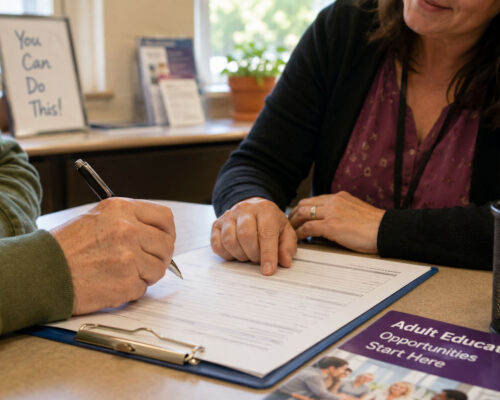
The details of intake, data, and follow-up matter because they shape how learners experience the system.
Learner dignity shows up in everyday details
- How students are welcomed
- How questions are asked
- Whether registration forms are understandable
- Whether students know what happens next
- Whether follow-up happens with care instead of judgment
That is why learner dignity has to be built into the system, not added as a nice extra.
The Program Side Taught Me to See the Whole System
My personal experience helped me understand what Adult Basic Education feels like from the learner side. But working around programs, data, registration, and reporting helped me see something else: even caring programs can accidentally create barriers when systems are not designed around real people.
Small system details can shape whether learners continue
- Registration: Can invite someone in or quietly discourage them.
- Forms: Can gather needed information respectfully or feel confusing and impersonal.
- Data systems: Can help staff notice who needs support or become another burden.
- Schedules: Can reflect adult learners’ lives or assume predictable transportation, childcare, work hours, and internet access.
None of this is simple. Adult Education practitioners are doing complex work inside complex systems. They are teachers, advisors, encouragers, problem-solvers, data collectors, compliance partners, and community connectors. They are often asked to document outcomes while also responding to the human realities behind those outcomes.
This is why I believe the conversation about Adult Basic Education has to include both heart and structure.
- We need compassion, but we also need good systems.
- We need student voice, but we also need program capacity.
- We need funding, but we also need thoughtful implementation.
- We need data, but it should help us see learners clearly instead of flattening their experiences into checkboxes.
And as technology becomes a larger part of education, workforce systems, and daily life, we have to remember something important: tools can open doors, but only if they are used with care. Learning can be powerful. Systems can be powerful. Technology can be powerful. But power without dignity, access, and human judgment can create new barriers instead of removing old ones.
Adult Basic Education Is Workforce Development
Adult Basic Education is sometimes treated as separate from workforce development, as though it is only the step before the “real” workforce conversation begins.
The Adult Education and Family Literacy Act, often called AEFLA, is the largest federal investment in adult education and literacy. AEFLA is also Title II of the Workforce Innovation and Opportunity Act, which connects adult education to employment, postsecondary transition, and workforce preparation (Adult Education and Family Literacy Act, n.d.).
That connection is important. When adult learners build reading, math, English language, digital, communication, and problem-solving skills, they are also building the skills needed to enter, retain, and advance in employment.
LINCS, an adult education and literacy resource supported by the U.S. Department of Education’s Office of Career, Technical, and Adult Education, describes workforce preparation skills as the knowledge, skills, and competencies that help individuals obtain or retain employment or advance in the workforce. These skills include communication, teamwork, collaboration, customer service, professionalism, critical thinking, and systems thinking (LINCS, n.d.).
They are the skills employers say they need. They are the skills families rely on. They are the skills communities benefit from when adults have more options and more stability.
But Adult Basic Education should not be reduced to workforce outcomes alone. Adults are more than workers. They are parents, neighbors, caregivers, leaders, volunteers, and community members. A strong Adult Basic Education system honors all of that.
The goal should not be to push adults through a pipeline. The goal should be to support adults in building choices.
Community Support Matters, But Learners Should Stay at the Center
Community partners can support Adult Basic Education in practical ways:
- Employers can support flexible scheduling, recognize skill growth, and partner with programs respectfully.
- Libraries can offer trusted spaces, technology access, digital skill support, and community connection.
- Community colleges can connect adult learners to credit pathways, training programs, advising, and financial aid conversations.
- Nonprofits can help address transportation, childcare, housing, food security, language access, and family support.
- Workforce organizations can connect education with career goals, training opportunities, and employment pathways.
- Local leaders and policymakers can protect funding, listen to practitioners, and treat ABE as infrastructure.
In Iowa, Adult Education and Literacy programs are described as helping adults acquire and improve functional skills needed to enhance quality of life as workers, family members, and citizens. Iowa Workforce Development also notes that educational services are available at little or no cost to adult learners and are designed to meet individual educational needs (Iowa Workforce Development, n.d.).
That kind of language matters because it recognizes adult learners as whole people, not just test scores or workforce outcomes. Adult Basic Education is not one narrow program. It is a bridge across many parts of life.
Supporting adult learners does not mean taking ownership away from them. It means removing barriers, respecting goals, and strengthening the systems learners are already navigating.
The learner should remain the center of the conversation. Not the form. Not the funding stream. Not the reporting requirement. Not the partner organization. The learner.
Student Voice Belongs in the Room
Because I entered this work as an adult learner, I believe strongly that student voice belongs in conversations about Adult Basic Education. Students understand barriers that may never appear in a policy document. They know what it feels like to walk into a program for the first time. They know whether the registration process feels welcoming or intimidating. They know whether class schedules match real life. They know what helps them persist. They know what makes them disappear quietly.
When programs listen to students, they do not weaken professional expertise. They strengthen it. Student voice can help practitioners and leaders ask better questions.
What are we asking students to do before they even reach instruction?
Do they understand the process? Do they know who to contact? Are forms accessible? Are technology steps clear? Are we assuming digital access or confidence that may not exist yet?
What does persistence look like from the learner’s side?
Are students missing class because they are disengaged, or because their lives are complicated? What supports might help them return instead of feeling like they failed again?
Where does dignity show up in our system?
Do students feel respected at intake? Do they understand their test results? Are goals built with them or for them? Do they see themselves as capable partners in the process?
These are not soft questions. They are systems questions. And they matter.
Why I Am Writing About Adult Basic Education
This first blog post is an introduction, but it is not only an introduction to me. It is an introduction to the kind of conversations I believe Adult Basic Education deserves.
- Learner dignity, because dignity changes how systems behave.
- Student voice, because learners should help shape the programs designed to support them.
- Data, because behind every number is a person.
- Workforce readiness, because adults deserve pathways that connect learning to real choices.
- Funding and policy, because good intentions do not keep programs open.
- Technology, because tools should make learning and program work more human, not less.
- Community partnerships, because no program can remove every barrier alone.
Most of all, I want to write from the place where lived experience meets system change.
Adult Basic Education changed my life. But it also changed the way I see every form, every data point, every intake question, every classroom, every funding conversation, and every learner who wonders if there is still a path forward.
And our job, as practitioners, advocates, partners, policymakers, and community members, is to make that path easier to find, easier to enter, and easier to continue.
Conclusion: The Work Is Bigger Than One Story
My story is one doorway into this work, but it is not the whole story. The larger story belongs to adult learners across our communities who are showing up with courage, experience, responsibility, and hope. It belongs to practitioners who keep building pathways even when resources are limited. It belongs to programs trying to balance compliance and compassion. It belongs to communities that understand education does not stop being important when someone becomes an adult.
Adult Basic Education matters because adults matter. Their goals matter. Their families matter. Their work matters. Their voices matter. Their futures matter.
When we build Adult Basic Education systems around dignity, access, persistence, and real human lives, we do more than help adults earn credentials. We help communities see possibility differently. And sometimes, that begins with one referral, one classroom, one teacher, one form, one conversation, or one adult realizing:
I am not starting over.
I am continuing forward.
References
Adult Education and Family Literacy Act. (n.d.). About AEFLA. U.S. Department of Education, Office of Career, Technical, and Adult Education.
Iowa Workforce Development. (n.d.). Adult Education and Literacy.
LINCS. (n.d.). Teaching Skills That Matter: Workforce Preparation. U.S. Department of Education, Office of Career, Technical, and Adult Education.
U.S. Department of Education. (n.d.). Adult Education and Literacy. Office of Career, Technical, and Adult Education.
Megan, you enter every room with strength and expertise in adult education. The fact that you continue to step into spaces and share your story and the story of adult education brings me hope for the future of our work. Thank you!
Erin Vobornik
COABE