

Sometimes a rule is written for a good reason. A credential requirement may be meant to protect quality. A hiring policy may be designed to create consistency. A documentation rule may help employers meet compliance expectations. In the right context, rules can create fairness, safety, and accountability.
But rules can also become dangerous when they are applied without context.
That is one of the reasons Adult Basic Education matters so much. It sits at the intersection of people’s real lives and the systems that shape their opportunities. It helps adults move forward, but it also helps systems see what they may have missed.
This reflection was inspired by a recent opinion piece by Mercedez “Mercy” Butts, founder and executive director of Joyce’s Legacy Learning Center (JLLC) in Milwaukee. In that article, Butts writes about working adults earning their GED not only to get ahead, but to protect the stability they have already built. She describes adult learners who are already established in work and community life, yet may be vulnerable to an audit, policy change, or employment requirement because they lack a recognized high school credential.
That distinction matters.
Adult Education is often discussed as a path to getting a job, and it is. But it is also a path to keeping a job, protecting dignity, and making sure a missing piece of paper does not erase years of skill, service, and contribution.
The Workers We Do Not Always See
When people think about Adult Basic Education, they may picture someone preparing to enter the workforce for the first time or someone trying to make a major career change. Those learners are part of the story, but they are not the whole story.
Many adult learners are already working. They may be caring for children, supporting aging parents, paying rent, volunteering in their communities, leading classrooms, running small businesses, serving in churches, or doing essential work that keeps local systems moving. They may have years of practical experience. They may be trusted by coworkers, families, clients, students, patients, customers, congregations, and neighbors.
And still, one missing credential can put everything at risk.
Butts names this reality clearly through her work at JLLC. The concern is not that these adults lack value or ability. The concern is that one documentation issue could threaten the stability they have already built.
A credential matters. It can open doors, meet requirements, and create mobility. But a credential does not create a person’s worth. It does not prove whether someone is hardworking, intelligent, responsible, creative, caring, or capable.
Adult learners often know this tension deeply. They may have raised families, managed households, held jobs, solved problems, survived crises, served others, and led in their communities for years. Yet they can still be treated as incomplete because a system is waiting for one document.
That is why Adult Education should never be talked about as a remedial service sitting on the edge of the workforce system. It is part of workforce stability, economic preservation, and community infrastructure.
The Credential Should Match the Craft
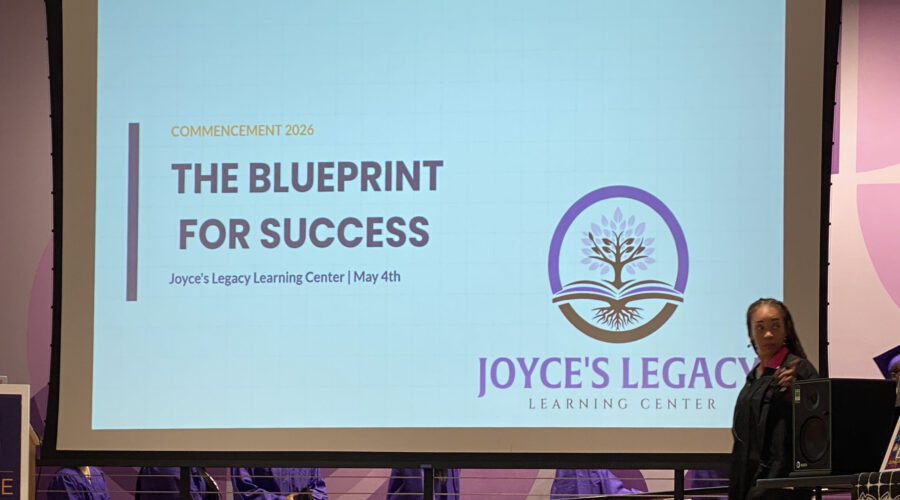
I thought about this while attending the Joyce’s Legacy Learning Center graduation.
The room was full of celebration. The screen read, “The Blueprint for Success.” Graduates wore purple caps and gowns. Families, friends, staff, and community members were there to honor what had been earned.
One of the graduates was a local pastor. During his speech, a little girl in the audience called out “That’s my pastor!” That moment stayed with me.
He was not standing there because he lacked purpose. He was not standing there because he lacked leadership. He was not standing there because he had not served his community.
He was standing there because his credential needed to catch up with the life he was already living. That child knew who he was. His congregation knew who he was. The people impacted by his service knew who he was.
That is the part of Adult Education people do not always understand. Sometimes the classroom is not the beginning of someone’s contribution. Sometimes it is the place where the system finally recognizes what the community has already known.
The diploma matters. The GED matters. The certificate matters. But the person mattered before the paper was ever printed.
Adult Education helps bring those two things together.
Protecting More Than Employment
When an adult earns a recognized credential, the impact can reach far beyond one job application.
It can protect current employment. It can reduce fear during an audit or policy review. It can help a worker qualify for advancement. It can support a parent helping their children understand the value of education. It can strengthen confidence, mobility, and long-term stability.
It can also help employers and communities.
When experienced workers are pushed out because of a missing credential, workplaces lose institutional knowledge, relationships, consistency, and trust. Communities lose people who have already been showing up. Families lose income and security. Systems lose the very people they often say they need.
That is why supporting Adult Education is not charity. It is strategy.
It helps workers stay connected to opportunity. It helps employers retain people with experience. It helps communities protect the talent, wisdom, and leadership already present among them.
The Role of Programs Like JLLC
Programs like Joyce’s Legacy Learning Center understand that adult learners are not statistics on a page. They are whole people with histories, responsibilities, fears, strengths, and dreams.
They may come to class after work. They may study while raising children. They may be caring for family members. They may be carrying shame from a school experience that happened decades ago. They may be trying to finish quietly because the world has not always been kind about what they did not complete earlier in life.
And still, they show up.
That is courage.
Adult Education programs create space for that courage to become progress. They help learners build skills, earn credentials, access opportunities, and protect what they have already worked hard to build.
They also help the rest of us see more clearly.
Because sometimes the problem is not the person. Sometimes the problem is a system that only recognizes one kind of proof.
Seeing the Full Story
Mercy’s article reminds us that adult learners are not always entering the workforce for the first time. Many are already holding pieces of the workforce together.
They are working. Serving. Parenting. Leading. Building. Caring. Teaching. Creating. Contributing.
They are not invisible because they lack value. They become invisible when systems fail to look closely enough.
Adult Education helps make the full story visible.
It says: your experience matters. Your work matters. Your goals matter. Your future matters. And yes, your credential matters too.
A missing credential should not be allowed to erase a lifetime of contribution.
Adult Education helps make sure it does not.
References
Butts, M. (2026, May 4). Opinion: The workers you don’t see are working to stay employed. Milwaukee Neighborhood News Service.